


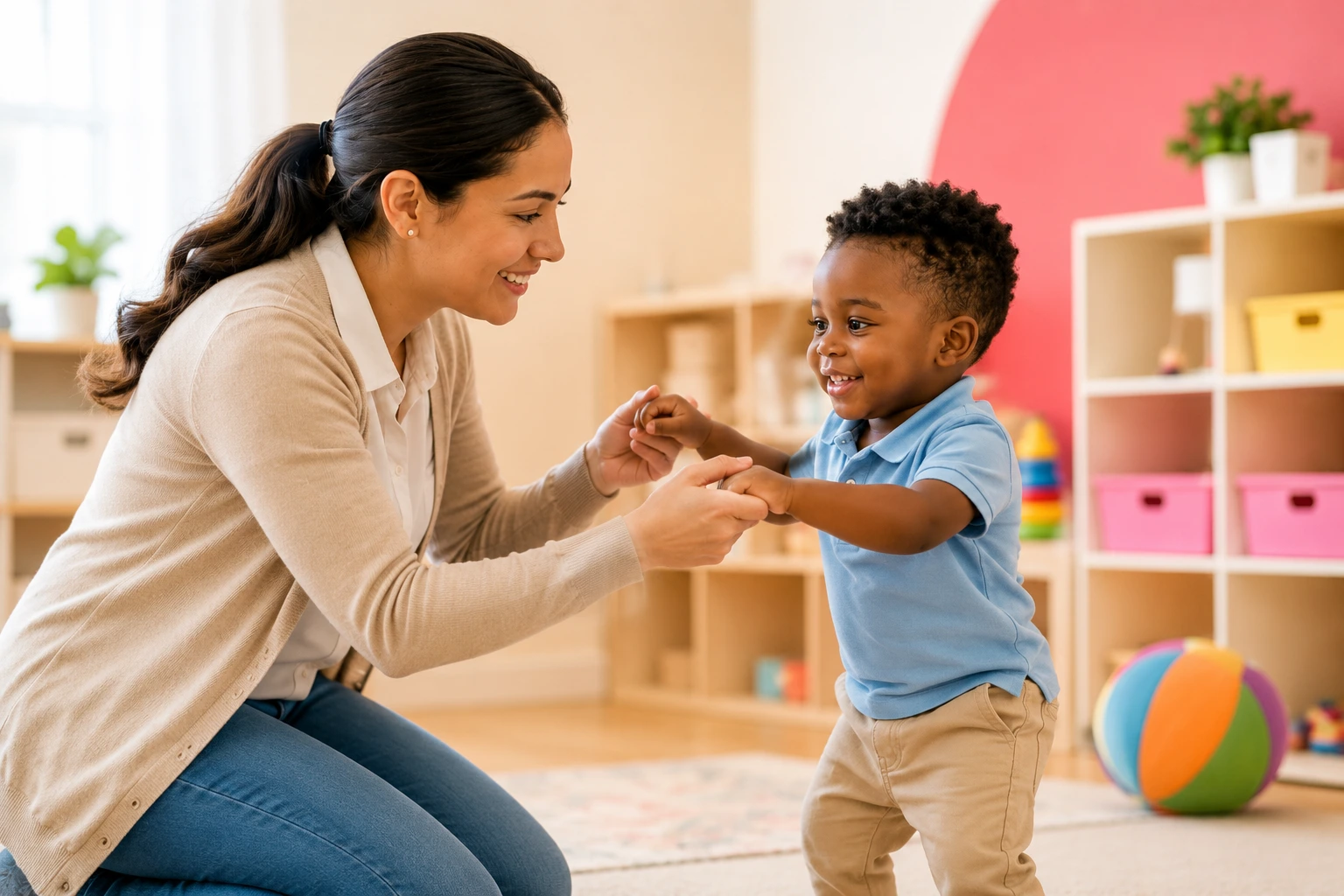
Children can practice motor skills through simple everyday activities like crawling, walking, climbing, ball play, stacking, drawing, and movement songs. These activities give infants, toddlers, and preschoolers chances to practice balance, coordination, hand strength, and body control through play.
Motor skill practice does not need to feel formal. A soft ball, a few blocks, a song with hand motions, or a safe space to move can give your child meaningful practice during the day.
At Nanda Learning Center, we use simple, age-appropriate activities that help children move, explore, build, draw, and play with support. These daily moments can give children opportunities to practice both large body movements and small hand movements.
If you have concerns about your child’s movement, coordination, or development, your pediatrician can help you understand what is appropriate for your child’s age and needs.
Motor Skills Grow Through Everyday Play
Motor skills are the movements children use to explore, play, and take part in daily routines. They include both large body movements and smaller hand and finger movements.
Gross motor skills involve larger body movements, such as crawling, walking, climbing, balancing, jumping, and throwing.
Fine motor skills involve smaller hand and finger movements, such as grasping, stacking, scribbling, drawing, picking up objects, and turning pages.
Both types of skills are practiced during everyday play. A toddler climbing safely onto age-appropriate equipment is practicing body control. A preschooler stacking blocks is practicing hand-eye coordination. An infant reaching for a soft toy is practicing movement with purpose.
Motor skill activities often work best when they are part of playful learning, where children practice new skills through movement, exploration, and hands-on play.
5 Activities That Help Develop Motor Skills in Children
Many helpful motor skill activities are simple, repeatable, and age-appropriate. Children do not need complicated toys to practice movement and coordination. They need safe chances to move, reach, grasp, balance, build, and try again.
1. Crawling, Walking, and Climbing Activities
Crawling, walking, and climbing give children chances to practice larger body movements. These activities may support balance, strength, coordination, and body awareness when they are supervised and age-appropriate.
For infants, this might mean tummy time, reaching for a soft toy, rolling, or crawling toward something interesting. These simple movements help infants explore how their bodies move.
For toddlers, walking on safe paths, stepping over soft objects, or climbing on age-appropriate play equipment can give them practice using their whole body with more control.
For preschoolers, simple obstacle paths can be helpful. A child might step over a cushion, crawl through a tunnel, walk around cones, or balance along a safe line on the floor.
The activity does not need to be difficult. The value comes from giving your child safe, repeated chances to move and explore.
2. Ball Play and Active Games
Ball play gives children a simple way to practice watching, reaching, rolling, kicking, throwing, and moving with purpose. It can be adjusted for infants, toddlers, and preschoolers.
For infants, a soft ball can be rolled nearby so they can watch it move, reach toward it, or touch it. For toddlers, rolling a ball back and forth can help them practice turn-taking and coordination.
Preschoolers may enjoy tossing a soft ball into a basket, kicking a ball toward a target, or playing simple follow-the-leader games. These activities give children practice paying attention, moving their bodies, and adjusting their actions.
Active games can also be simple. Marching, hopping, crawling like an animal, or walking slowly and quickly can all help children notice how their bodies move.
3. Music, Movement, and Action Songs
Music and action songs help children connect words, rhythm, listening, and movement. They also make movement feel fun instead of forced.
For infants, music may include gentle clapping, soft movement, or songs with repeated sounds. Watching your hands move during a song can give your child something to follow with their eyes and body.
For toddlers, songs with motions can be especially helpful. Clapping, stomping, waving, touching toes, or marching in place can help your child connect directions with actions.
For preschoolers, movement games like freeze dance, animal walks, stretching, or follow-the-leader can help with balance, coordination, and listening.
Music also makes transitions easier for many children. A cleanup song, handwashing song, or movement song can help children move from one activity to the next with more ease.
4. Building and Stacking Toys
Building activities give children practice using their hands, eyes, and attention together. Blocks, nesting cups, large puzzle pieces, and connecting toys can all support fine motor practice.
For infants, this may begin with grasping a soft block, reaching toward a toy, or transferring an object from one hand to another.
For toddlers, stacking blocks, knocking them down, and trying again can help build coordination and patience. Nesting cups can also help children practice fitting objects together and noticing size.
For preschoolers, building can become more planned. Your child may create a tower, bridge, house, road, or pretend structure. This gives them practice using their hands while also thinking through what they want to build.
Building does not need to follow a perfect plan. Even simple stacking gives your child a chance to practice grip, balance, focus, and hand control.
5. Drawing, Scribbling, and Simple Art
Scribbling and simple art can help children practice hand movements they may later use for early writing. These activities also give children a way to create, explore color, and use their imagination.
For infants, art may be limited to safe sensory experiences, such as looking at bright colors or touching approved materials with close supervision.
For toddlers, large crayons, finger painting, stickers, and sidewalk chalk can help them practice grasping, pressing, reaching, and moving their hands across a surface.
For preschoolers, drawing lines, circles, shapes, or simple pictures can help children practice more controlled hand movements. Tearing paper with help, placing stickers, or using child-safe art tools can also support hand strength and coordination.
The finished artwork does not need to look a certain way. The process of moving, grasping, pressing, and creating is what gives children useful practice.
How Childcare Routines Can Support Motor Skill Practice
Children often get more out of movement and hands-on activities when those activities are part of a steady daily rhythm. Active play, quiet play, outdoor time, art, music, and transitions can all give children different ways to practice motor skills.
At Nanda Learning Center, our staff can guide children through movement and hands-on activities while keeping the experience playful and age-appropriate. We understand that infants, toddlers, and preschoolers need different kinds of support as they move, explore, and try new skills.
Movement and hands-on play are easier to support when they are part of a steady daily routine. In our childcare and preschool education, children have opportunities to practice movement, coordination, creativity, and age-appropriate self-help skills throughout the day.
Daily routines can also help children shift between active and quiet activities. A child may run outside, then come inside for art. Another child may build with blocks, then join a song with hand motions. These small changes give children a range of ways to use their bodies.
What Parents Can Ask During a Daycare Tour
When you visit a daycare or preschool program, it can help to ask how movement and hands-on play are included throughout the day. These questions can help you understand whether children have time for active play, creative work, outdoor movement, and quieter fine motor activities.
When you are choosing the right daycare, it can help to ask how children get time for movement, creative play, outdoor activities, and hands-on learning.
You can ask questions such as:
- How do infants, toddlers, and preschoolers get time to move?
- What kinds of art or hands-on activities are included?
- How are activities adjusted by age?
- How are children supervised during active play?
- How do staff balance active play and quiet activities?
These questions can make it easier to picture your child’s day. They can also help you understand how movement, creativity, routines, and supervision work together.
Simple Activities Can Support Daily Growth
Motor skill practice can happen through small, everyday moments. A child may reach for a toy, crawl toward a favorite object, roll a ball, stack blocks, scribble with chalk, or clap along to a song.
When you visit Nanda Learning Center, you can ask how movement, art, play, and daily routines are included in your child’s day.
You do not need complicated activities to help your child practice movement. Simple play, repeated often, can give children meaningful chances to build confidence, coordination, and body awareness over time.
If you want to learn more about our programs and how we support children through age-appropriate activities, you can schedule a tour.


Leave a Reply